
Types of NYC Corporate Event Videography & Production Companies And How To Choose The Right One For You

Part 1: Understand the Three Common Service Model
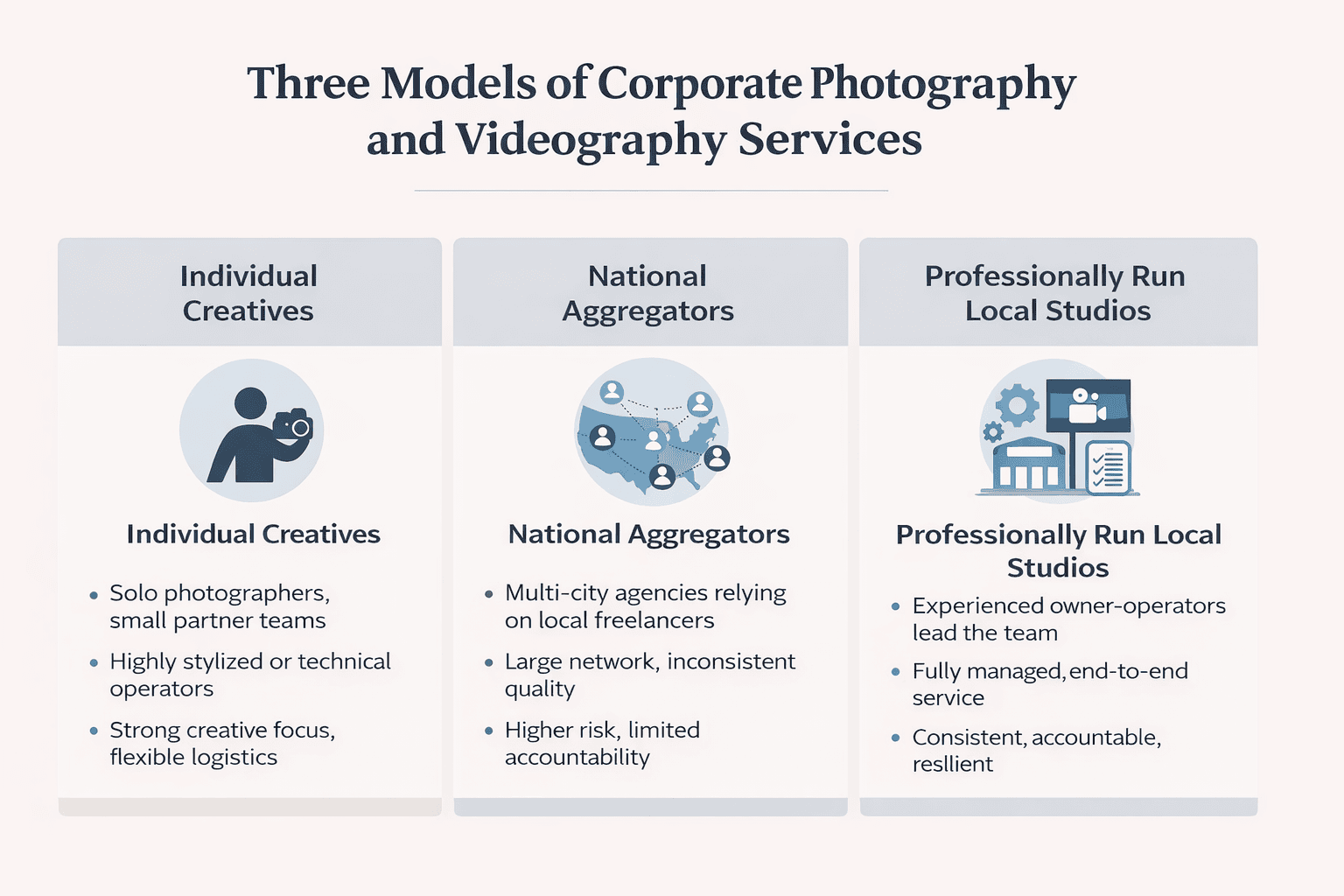
Before comparing portfolios, it helps to understand how most photo and video services are structured. Over the years, corporate event coverage has largely fallen into three broad models. Each has its place, depending on how much complexity the event carries and how much oversight the planner wants to personally manage.
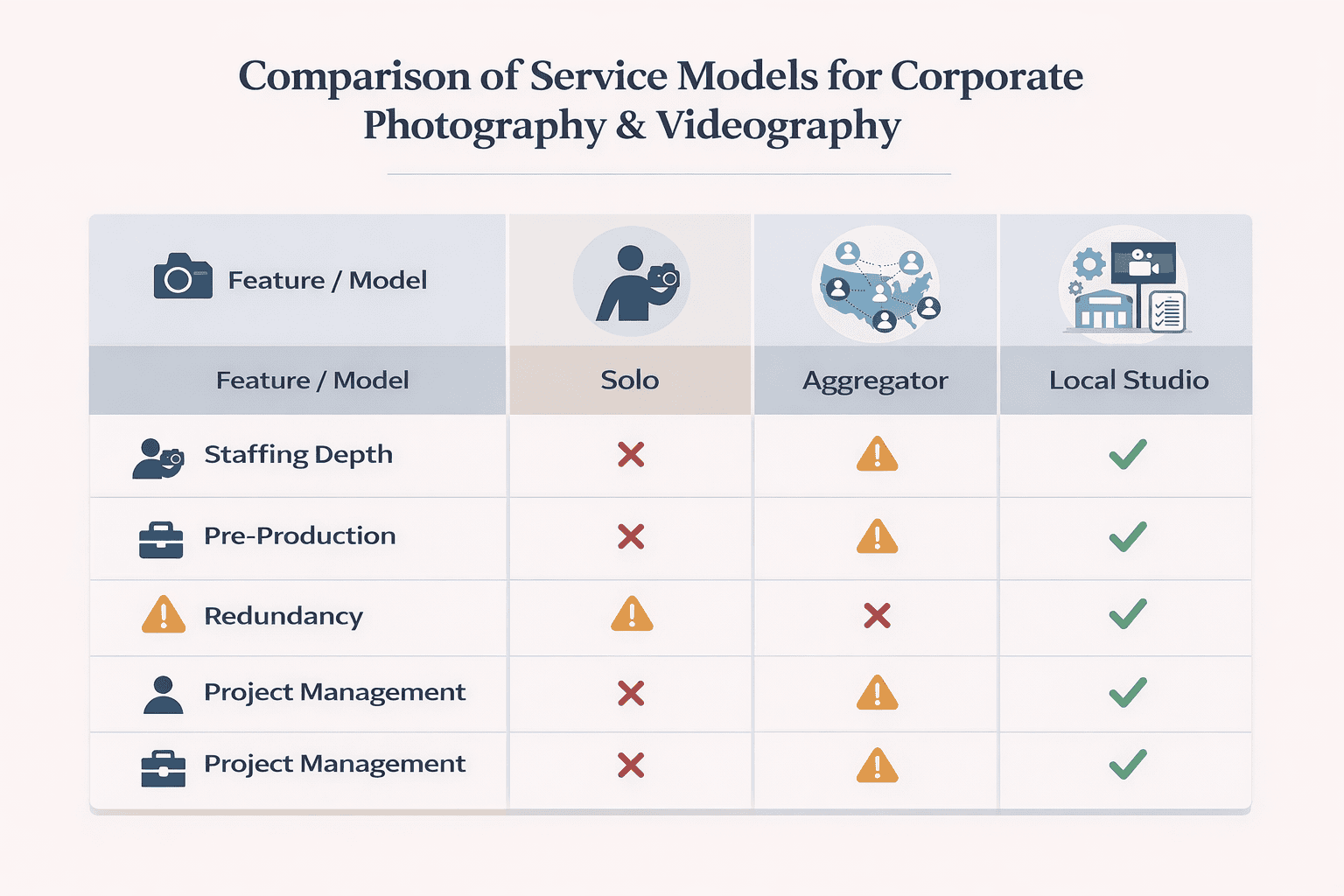
1. Individual Creatives (Artists & Technicians)
This includes solo photographers, small partner teams, and highly stylized or highly technical operators.
These professionals are often very talented creatively or technically. Their primary focus tends to be the craft itself: lighting, composition, camera mastery, or a specific visual style.
They can be an excellent fit when:
- The scope is simple
- The event is small or single-room
- The planner is comfortable managing logistics closely
- There is flexibility if something changes
Where this model becomes challenging is in multi-room events, conferences, or productions that require layered coverage, redundancy, or real-time problem solving. In those environments, success depends not only on talent, but on staffing systems, backup planning, communication structures, and accountability.
2. National Aggregators
These are multi-city agencies that rely on large networks of local photographers and videographers.
They often promote models such as “free shoots” or “pay only for the photos you love.” On the surface, this can sound attractive. In practice, this structure can introduce higher risk.
Because these companies do not usually employ their shooters directly, accountability for quality, staffing, consistency, and outcomes is often distributed. The planner may end up acting as the de facto production manager: clarifying expectations, troubleshooting issues, and absorbing the risk if someone cancels, arrives unprepared, or misinterprets the scope.
This model may work for standardized, low-risk coverage. It becomes far more fragile when the event is high-visibility, fast-moving, or operationally complex.
3. Professionally Run Local Studios
These are established studios led by experienced owner-operators.
They blend creativity with technical execution, while also managing staffing, planning, workflows, and contingencies. In many cases, the owner has personally photographed or filmed hundreds of events and can step in to shoot, direct, or manage post-production if something unexpected arises.
This structure allows for:
- Intentional crew building
- Real pre-production planning
- Backup systems
- End-to-end accountability
When planners are looking for a fully managed, low-risk, turnkey experience with minimal oversight, professionally run local studios tend to provide the greatest consistency and peace of mind.
Part 2: Why Crew Size Matters More Than Most People Think
One of the most misunderstood parts of hiring a corporate event videographer or production company is staffing.
Crew size is not about luxury. It is about coverage integrity.
Every camera operator can only be in one place at one time.
If two important things happen simultaneously and one person is assigned to both, something will be missed. No level of talent can solve that.
Coverage integrity means:
- Key moments are not sacrificed for convenience
- Breakout rooms are not ignored to protect the main stage
- Networking is not lost because a camera is locked to a podium
- Equipment issues do not collapse the entire production
Multi-room and multi-track events require intentional staffing. That means designing coverage based on program flow, not based on a flat headcount.
Production assistants are also a critical but often overlooked layer. They protect coverage quality by handling logistics, managing movement, coordinating transitions, supporting lighting and audio, and freeing camera operators to stay focused on capturing content rather than troubleshooting.
A professional production company should be able to explain exactly how many people are needed, where they will be placed, and what role each person plays in protecting outcomes.
Part 3: Videography Essentials – B-Roll vs Full Program Recording
One of the most common sources of dissatisfaction in corporate video is not editing style. It is unclear intent.
Video must be chosen intentionally. When clients do not clearly define whether they need documentation, marketing footage, or both, they often end up unhappy with the result.
There are two fundamentally different goals in corporate event video:
Full Program Recording
This is documentation.
It includes:
- Complete keynote recordings
- Panels and sessions from start to finish
- Clean audio capture
- Locked or directed multi-camera coverage
- Archival, training, or internal distribution use
This requires a mindset focused on continuity, stability, audio integrity, and redundancy.
B-Roll Event Coverage
This is storytelling and marketing capture.
It includes:
- Atmosphere
- Attendee interactions
- Branding details
- Reactions
- Motion visuals for highlight films, promos, and social content
This requires mobility, creative framing, anticipation, and narrative awareness.
Why one person cannot do both well
Full program recording and B-roll are different jobs.
One requires staying locked, stable, and technically controlled. The other requires constant movement, creative choices, and moment-hunting.
When one operator is asked to handle both, something always suffers: either the program coverage becomes incomplete, or the creative footage becomes thin.
The same principle applies to photography and video. One person cannot photograph and film at a professional level simultaneously. They involve different lenses, positioning, lighting approaches, and mental focus.
When both outcomes matter, staffing must reflect that.
Many high-level events benefit from hybrid video coverage: full program recording plus B-roll, supported by two or more dedicated operators. A professional team should help design this intentionally rather than leaving it ambiguous.
Part 6: When Professional Planning Saves Events
Case #1: Hurricane conditions, last-minute scope expansion
During severe weather and flooding, a client added photography coverage between video sessions. Because the studio was Manhattan-based, equipment access was immediate. Staffing was adjusted. Full photography and video coverage was delivered the same day.
Geography, infrastructure, and team depth become production assets in New York.
Case #2: Winter storm risk planning
When a major winter storm was forecast, hotel rooms were secured near the venue days in advance. While many teams arrived late or not at all, coverage began on time.
This is pre-production. Not luck.
Case #3: Owner-operator intervention at a major performance venue
During a large multi-school event at Brooklyn Academy of Music, unexpected audience chants became central moments. Program cameras were positioned for stage coverage only.
Because the studio owner was onsite and operationally active, handheld coverage was added immediately. Some of the most important footage of the event was preserved.
This is where professionally run studios fundamentally differ: leadership is not theoretical. It is functional.
Part 7: How Poor Planning Shows Up in Post-Production
Editing cannot fix missing structure.
The most common post-production failures are not software problems. They are production problems.
1. Full program recording without B-roll
Clients often request documentation, then later want dynamic edits with reactions and cutaways. Without additional cameras or B-roll coverage, visual storytelling becomes impossible. Audio may survive. Visuals often cannot.
2. Undisclosed deliverables
When clients do not fully disclose what they want captured, teams cannot bring the correct lenses, equipment, or staffing. Technical limitations then appear later as editing obstacles.
What seems like a “small add-on” onsite can become a major post-production compromise.
3. Understaffing
When moments overlap and coverage is thin, post-production reveals gaps no edit can fill.
Editing can refine. It cannot invent.
4. Exposure and equipment limitations
Overexposed footage is unrecoverable.
Motion blur from slow lenses is irreversible.
These are not artistic choices. They are production standards.
5. Inexperience in storytelling
Even technically correct footage becomes unusable if the wrong moments were captured or the wrong people were prioritized.
Relevance cannot be corrected in post.
Part 8: The Corporate Event Video Hiring Checklist
When evaluating a NYC corporate event videographer or production company, consider:
Structure & Accountability
- Who owns the company?
- Who is responsible if something goes wrong?
- Who oversees planning, staffing, and delivery?
Staffing Design
- How is crew size determined?
- Who covers simultaneous moments?
- Who protects continuity?
Intent Definition
- Are we documenting, storytelling, or both?
- Who is assigned to each outcome?
Process
- What does pre-production include?
- How is the run of show reviewed?
- How are changes handled onsite?
Pressure Management
- What happens if equipment fails?
- What happens if conditions shift?
- Who makes real-time decisions?
Post-Production
- Who edits?
- What workflows exist?
- What timelines are realistic?
Professional teams welcome these questions. The clarity of the answers usually predicts the success of the event.

Quality photography and video go far beyond simply looking good.
They determine how an event lives on after the doors close. They shape how the experience is remembered, how stories are told internally and externally, and how the value of the event continues long after the final guest leaves. The full production experience matters because clients and attendees don’t just remember what happened — they remember how the event made them feel.
An experienced team brings more than cameras. They bring professionalism, consistency, problem-solving ability, and reliability under pressure. That is why investing in professionals is not simply a creative choice. It is an investment in peace of mind.
When staffing, planning, and expectations are aligned early between planners, venues, clients, and photo and video professionals, the entire event ecosystem becomes stronger. Communication improves. Pressure decreases. Outcomes improve. And most importantly, the client experience is protected.
In an environment as complex and fast-moving as New York, that alignment is not optional. It is foundational. You can read about it in our comprehensive guide on hiring a professional photographer and videograher in New York in 2026.
